Living as a junior scientist comes with a tight budget. It is rare to see someone living on a generous student stipend. And even for a postdoc, the range of salary is tight. It is just enough to live in that area. So if you have a family to support or paying back some student loan, financial issues always follow you.
Also, we tend to move around. So buying some everyday items such as furniture for your flat does make you wonder whether it is reasonable to do. You want some quality but you might not use it for the long term. Time like these days, working from home is essential for you. We can face a conflict of interest here, money vs. needs.
So I share some neat ways to save some money and, you can also contribute some good action to the environment at the same time.
Olio
Mainly focused on reducing food waste, but you can also find decent other non-food items. Non-commercial. Free donation between users. Lots of supermarket chain staff are participating to reduce the waste. They added the ‘made’ section, in which people can sell and buy homemade food and sustainable handmade crafts.
Platform: app/web
pro: app, distance-based search, profile with picture and rating
con: you want to use the exact keyword. with ‘duvet’ you cannot find ‘duvets’. The app-based interface can be a barrier for the older generation, who has more potential to share.
The website offers a combined search for ‘freecycle.org’ and ‘freegle’, which I explain below. It is a nice independent project which can help users better navigate these two free sharing websites. Some communities may not include in the list provided by this website.
freecycle.org
Volunteer organized communities sharing items. More on non-food stuff. Non-commercial. Only free donation to each other. Town-based communities.
Platform: web
pro: well established and long history, attracts more older generation locals.
con: lots of ads are without pictures, distance-based search not possible. No function for review, more anonymous.
Similar concept as freecycle, also the app is supported. Seems like only in the UK.
geev
It seems like a similar concept app.
too good to go
When restaurants, cafes, and supermarkets have some unsold items, they usually have to throw them away. So this app tries to connect potential customers who want to participate in reducing food waste with these sellers. Normally the Price is much reduced from the usual price, but you cannot choose what you get.
platform: app
pro: You can get restaurant-quality food. This means the quality or the safety of food would be guaranteed. Food is already packed in a suitable container. app-based reservation system, review and scoring of customer satisfaction, distance-based search, category based search, pre-announced price.
con: you don’t know what you get
where: 15 countries Netherlands, France, Denmark, Portugal, Belgium, Poland, Switzerland, Austria, Spain, Sweden, Norway, Germany, Italy and the United Kingdom and most recently the USA.
summary
It seems that freecycle.org has been and still is the most popular one of this kind. So I guess you could google search in your region with ‘similar freecycle’ or ‘alternative freecycle’. And find something most reliable and widely used community in your area.
Also, you can search ‘food waste app’ to find something similar to ‘Olio’ or ‘too good to go’ and save some grocery budget.
Living abroad helped me see through other person’s point of view, especially expats who stay in Korea. Now I can roughly picture the difficulties that foreigners living in Korea would face. There are a few things I heard from friends, but most of the stuff I have written here is the recent epiphany, being in expats’ shoes, after suffering in a foreign land.
Korea has been a relatively closed society for expats. It is geographically isolated like a big island because of North Korea and 3 coastlines. It has not been long since people started crossing the Korean border in earnest as it can be seen from the fact that even Korean citizens began their free international travel without discrimination in 1989. We have historical scars with our two closest neighbours, Japan and China. So, the only foreigners I saw before I became an adult were the US soldiers who came to my valley for military training. And since it is a country mainly composed of a single ethnicity with a single culture, it seems that our capacity to deal with cultural differences is not mature yet. Hopefully, this might change soon. The number of foreigners has increased quite a bit on the streets of Seoul when I recently visited. For simplicity of the topic, here let’s talk about food culture.
Food difficulties you can have in Korea
Lack of understanding of dietary requirements. The fact that Koreans do not have special dietary restrictions can lead to a lack of understandingand consideration for cultures with specialfood ingredient restrictions. We are really not used to this concept. So, when foreigners start living in Korea, it can be difficult for them to satisfy their preferred eating habits.
Vegetarian and gluten-free? For example, if my parents’ generation meets someone who is looking for a strict vegetarian diet, no matter what the situation is, they will ask ‘WHY?’ without hesitation and may insist that you should eat meat. Because when they were young, any kind of meat was a rare and special ingredient, lots of them suffered from the deficiency of animal protein. Anyhow, most restaurants owners are older generations so it could be not easy for you to ask them whether they have a vegetarian menu and get a positive response. For a similar reason, gluten intolerance is almost unheard of in Korea.
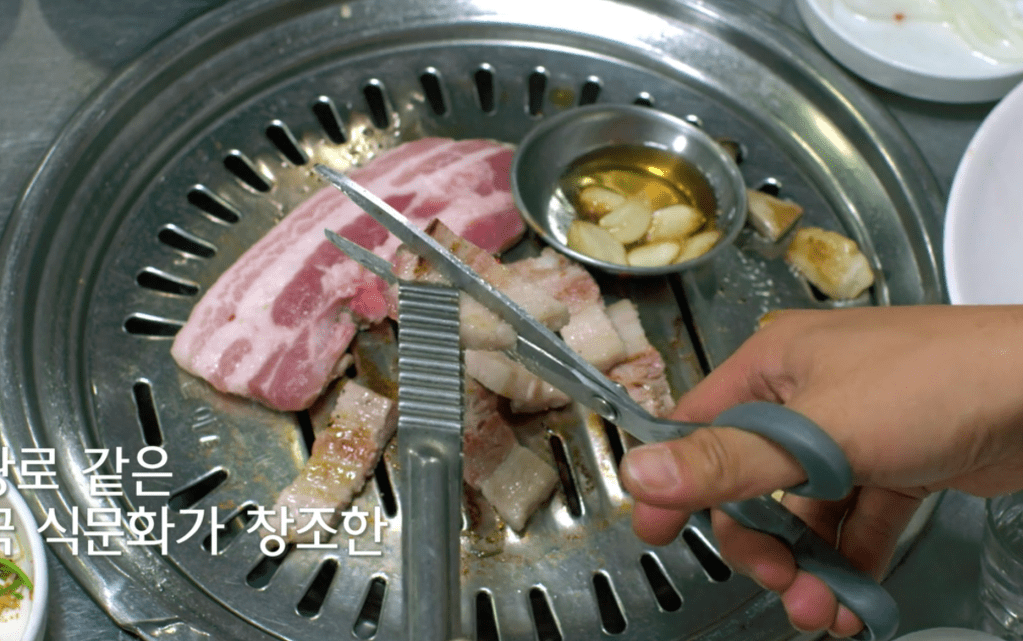
Halal foods. People with Halal food culture may face many prejudices in Korea, where people love pork, especially obsessed with grilled pork belly (Samgyeopsal 삼겹살, if interested check Netflix series ‘Korean Pork Belly Rhapsody’). In Korea, the scenery of sharing glasses of soju with grilling pork-belly is almost iconic for co-workers parties. As you can imagine it is really difficult to find Halal foods in your local supermarkets. You might want to visit a certain district where sizable Muslim communities reside.
photo from news.joins.com
How about kimchi? (김치: fermented salted spicy vegetable) It may become a bit better known through the mass media nowadays, but I think it is completely normal when a foreigner tries kimchi for the first time and she/he is shocked. As it is a fermented food, it has a strong smell, sour taste, peculiar texture, and even spicy taste. Although we eat them almost every meal, some Koreans hated kimchi when they were small, sometimes their parents fed it to them semi-forced. Although I love it, I think some Koreans do tend to recommend kimchi to foreigners with a bit too much eagerness.
Using spicy pepper everywhere. Unless you’re a spicy pepper lover you have to be careful in Korea. By my standards, the average French (or European) has a weak tolerance for spicy peppers. These people should be careful when ordering food in Korea. It is quite common to use a generous amount of pepper in Korean cuisine and when native servers in Korea say that ‘it is not spicy’, that is not the zero level of spiciness that you think it is.
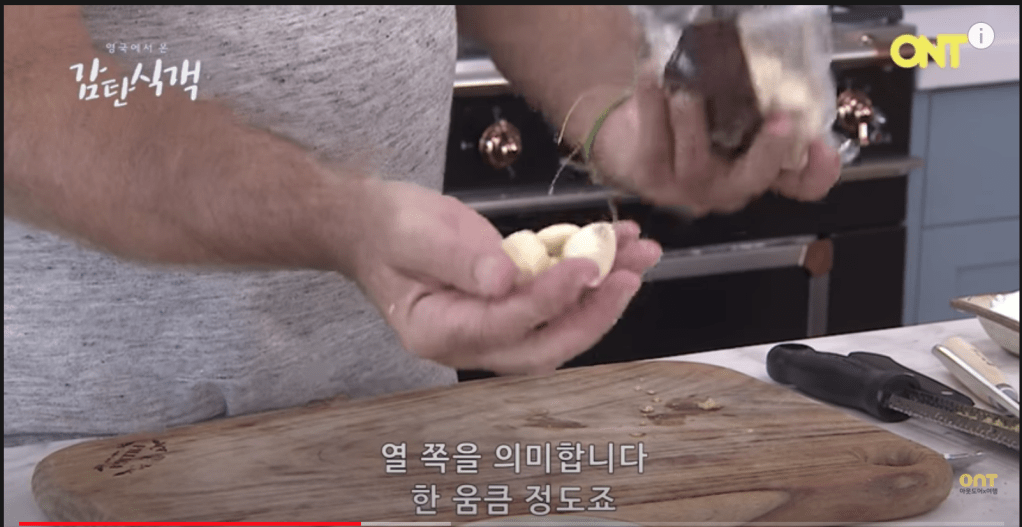
Koreans love garlic. We already use quite a generous amount of garlic when we cook with heat, but we also use plenty of raw garlic, which is sometimes close to the level of vegetables rather than spices. So if you don’t like garlic, you may want to be picky at the beginning.
You may be surprised by the strange flavours of sesame leaves, which are commonly used as fresh vegetables.
Limited dairy products. If you love cheese, you may find yourself frustrated with dairy products that lack both quality and variety. As can be seen from the fact that the first successful modern cheese production was accomplished by a Belgian missionary only in 1969, Korea does not have a rich dairy culture.
Lamb and mutton, sorry it is not that common to find them in local shops. You wanna go to certain foreign (means non-Korean) restaurants or some district with lots of foreigners. Ah if you go to any Chinese districts, you will find nice restaurants serving lamb skewers on the grill (양꼬치). I recommend trying them with an ice-cold beer!
skyedaily.com
Low awareness of food allergies. Food allergens, such as shrimp and peanut allergies, are also an important difference. In Korea, food allergies are generally not taken very seriously. The symptoms of serious food allergies seem to be few. There might be a bit of underestimation because only recently awareness has been raised and only a few related research has been established. But still, the difference seems obvious. For example, the occurrence of food-related anaphylaxis (severe allergic reaction such as difficulty breathing) in children under the age of 18 is about 1/50 compared to the United States. Probably there are some differences in genetics and dietary habits. Maybe this has something to do with the sad past when everybody was starving? In the dark time, only the strong survived…
They don’t drink water from the tap. Surprisingly, only a small portion of Koreans are drinking water from the tap. If you have lived in a country like France, Canada, or Japan, you may be surprised by this. The ratio of the population who directly drinks tap water is only 5% and it is the lowest level in OECD. Whatever the cause, having to pay the additional cost for drinking water could be annoying for an expat.
Strange communal spoon dipping. It’s getting a lot better these days, but ‘communal dipping’ will baffle a lot of expat. This is an act of eating while everyone dipping a spoon in one large pot instead of serving it in a private small bowl. It usually happens when you eat hot soup or desserts like ice-cream. This one I don’t have any good defence. It seems to have started mainly at the family table and expanded to the concept of expressing intimacy with others as well (but how?).
Personally, while living in Korea, I always wondered why most people are ok with it. Especially after the understanding of cancerous gut bacteria Helicobacter, which can be transmitted by saliva.
Many Koreans still tend to regard this as our warm tradition, but in fact, strictly speaking, the original Korea table manner was everybody getting their own small table. Probably, the culture had lost and changed as we went through a difficult period of starvation after the Korean War. I think with coronavirus pandemic, this will disappear rapidly due to increased sanitary concerns.
They cut food with scissors. There are many people who feel unfamiliar with kitchenscissors, which are commonly used in restaurants and homes to cut foods in Korea. It seems odd because they are reminiscent of office supplies. But personally, I think it’s convenient.
Netflix series ‘Korean Pork Belly Rhapsody’
Seating on the floorculture could be tough for you. There are still quite a few restaurants that don’t have chairs so you take a sit on the floor with a low table. On top of this, you have to take off your shoes. For some people, you may feel like you’re being punished or doing yoga while dining.
Heavy breakfast. In the case of a family who eats old fashioned way, the composition of breakfast, lunch and dinner does not change significantly, and this makes breakfast considerably heavier in quantity and appearance compared to other cultures. Spicy food, meat, and hot food are commonly served for breakfast.
Offering drink too often at the party. When drinking booze, we are too much concerned about the empty glass of others, we think refilling your glass is equivalent to being polite. So those expats who want to drink at their own pace may feel that Koreans tend to offer drink too much. In the past, liquors were precious, drinking them was a special event. Probably because producing alcohol is an act of reducing the nutritional value of the grain. So, it seems that offering alcohol has been translated into the meaning of conveying hospitality and goodwill.
There should be good side also
I would like to mention some of the possible good aspects of food culture in Korea. Since it is a country that is not well known, it will be fun to discover new things. There are few restrictions on ingredients. As food delivery (delivery in general) is extremely well developed, people sit in the park and can get beer and chicken delivered, sit in the ballpark and receive barbecue delivery to the seat, and even order food delivered at 3 am. The cost of eating out is relatively cheap compared to the price of living. With the low crime rate and 24 hours open restaurants and convenient stores, you can safely enjoy drinking and eating out any time of the day.
If you are gluten intolerant, Korea might be not that bad for you. Korean staple grain, rice is gluten-free. It cannot completely replace wheat, but its abundance and variation of its cooking might be a surprising delight for you.
In most restaurants, side dishes are refilled for free. When I lived in Korea, I hadn’t thought about this as an advantage, but I remember being shocked to see that I had to buy each side dish at a Korean restaurant in Paris. Also, no matter which restaurant, office, or school you go to, the drinking water provided by the water purifier is always free.
Korea has a culture that expects a fairly high level of kindness from the servers. Servers’ kindness perceived as a duty, so even in the case of a mid to low price range restaurant, you can get bit awkwardly kind servings. Considering that it is a country that has no tipping culture at all, this might be surprising. Oh, there might be a difference in how they treat Koreans and foreigners (I hope not..).
I believe this topic can be further expanded by someone who has lived in Korea!
When you pursue your research as a graduate student or postdoc, you face questions and issues like the above that are not directly related to your laboratory work but quite critical to your personal life. When that happens, you want to talk with somebody who can listen to these issues, not the progress of the project. If they can give you realistic advice about your future career? it would be the icing on the cake.
Unfortunately, there are not many such mentors or friends available around science nomads like us. It would be even worse if you had already left your hometown and living in a foreign community.
Why don’t you discuss your future career with a professor or a boss and talk about your current life with your colleagues? Well, it could be an ideal case if they can deliver what you actually need. However, for various reasons, this could be hardly the case.
Because
They are busy, busy and busy.
They don’t know or care about things outside of academia.
Conflicts of interest may arise. With colleagues, you may be in competition within the project, or your quitting research may be negative for their careers. In the case of a boss, normally she/he wants PhD students or postdocs to stay with her/him longer and only focus on the current work.
What if they don’t have the mentoring skills to listen to you?
Why bother? Is there a direct benefit for them in doing so?
Given this limitation, until recently, thirst for a mentor was such a problem without foreseeable solutions. Even if people who share the same concerns meet in the lab, it is difficult for any junior researchers to have a broad and objective perspective to see the current issues around them, and the seniors in the next level tend not to turn around and help youngsters because they are occupied with imminent problems, forgetting the time of vulnerability. Maybe you just don’t know where to find them and also potential mentors don’t know how to reach you.
In that case, what if you could listen to the story of someone in a similar situation? what if someone tells you realistic alternatives to these issues? Luckily there are some people who attempt to provide a new way of communicating and mentoring fellow researchers, using the power of the internet and social network service. After I discover them I realised that the audio and the video have a special appeal over the text. So, let me show a few examples of these new type of online mentors that could quench our thirst.
YouTubers
Grad School Advice
Justin now a scientist in the industry was a former postdoc at Havard medical school. Based on his personal experience combined with other advice he got from others, he explains fairly useful tips. He provides standard golden rules for grad students and your postdocs. Channel is in its infancy, so if you leave a reply you could get direct feedback.
This is for – when nobody told you how to write a CV, how to contact PI
Contents – tips for each step such as contacting PI, writing a CV, the fame of PI vs school
Mentoring level – like former alumni, less formal
Background – biology
Feeling about academic – no hard feeling
PhDCoffeeTime
Dr Vera Chan, a former biologist, now a medical writer, who did 6 years of postdoc wants to share her tips for a successful PhD. From Hongkong to the USA to France, she can share a wide variety of tips and decision advice.
This is for – PhD students who need various tips in general
Contents – using graph program, thesis writing, practical tips
Mentoring level – friendly, informative youtube
Background – biology
Feeling about academic – positive
Andy Stapleton
Channel name is his own name, a former chemist, stopped working as a postdoc, now uploading many useful tips about PhD life questions, and tips. originally from the UK and studied in Australia.
This is for – somebody wondering should I do PhD?
Contents – all the questions about PhD
Mentoring level – friendly, informative youtube
Background – chemistry
Feeling about academic – disillusioned
Cheeky Scientist
They offer services of mentoring and interview as a commercial consulting group. So not all of their contents are free but their website and youtube channel already provide tons of useful practical information without a subscription. I think the amount of stuff they offer for free is already quite generous and fairly detailed. Their way of pitching the idea is super direct which is quite unique and interesting. They don’t mind criticising the current academic system. If you want to make a full transition to the industry from academia, you definitely want to check this. They mainly deal with stuff in relation to the US market.
This is for – who wants to make the full transition to the industry (in the US)
Contents – how to write a resume to how to negotiate your salary, wide and in-depth, professional
Mentoring level – professional and commercial
Background – all domain
Feeling about academic: they think the current academic system is fooling and exploiting youngster
Lucy Kissick – The PhDiaries
Lucy Kissick, in a final-year PhD student at the University of Oxford,
“The PhDiaries is a YouTube channel for PhD students to find advice, relatable misadventures, and comfort in knowing they’re not alone in their problems, all in under five minutes and usually once or twice a fortnight.” (direct quote)
This is for: thinking about doing grad or young PhD grad.
Contents – advice and tips about the life of a PhD
Mentoring level – like a friend
Background – earth science
Feeling about academic – positive
Tibees, or keyword ‘quit PhD’ in YouTube
This YouTuber mainly deals with fun scientific facts. Only fes clips with personal testimonials are fit with this post. Due to the pandemic, there are more people making youtube about quitting PhD, so search ‘quit PhD’ in youtube to check more testimonials across the world.
This is for: who wants to listen to an honest testimonial
Contents – fun scientific facts
Mentoring level – like a friend
Background – theoretical physics
Feeling about academic – no hard feeling, disillusioned.
Navigating Academia
Jay Phoenix Singh is a professor of both UPenn as well as Cambridge. He is also offering coaching services on his webpage. He deals with various topics mainly heading towards young faculty members but also general tips for PhD and postdocs also. postdoc/grad Interview questions, how to publish more, book writing, or ethical issues in academia.
This is for: young professors or students wondering what professors point of view.
Contents – Advice, tips, QnA
Mentoring level – professional, with tones of typical YouTubers
“Career & Life Balance Exploration. for Academics and Graduate Researchers” (direct quote). I could see Dr. Vera Chan also as a speaker (connected!). Especially if you are French speakers, more useful because half of contents are in French.
“Wouldn’t it be nice if someone shared the secrets for success at every stage? Admissions, rotations, classes, quals, research, dissertations, job-hunting” (direct quote)
“Listen here for the hard-won financial wisdom of your fellow graduate students, postdocs, and PhDs with Real Jobs.” (direct quote) Talking about finance! Unique!
“peers behind the curtains of our professional lives to reveal some of the thoughts, feelings, best practices, and questions that we have about work as graduate student/postdoc career professionals (and sometimes about chickens.)” (direct quote)
Many science nomads are investing in their careers at almost 100% expense of their own vacation and hobbies, but eating is different. Because you can’t live without eating. Eating is an instinctive pleasure and also a basic action for survival. In that sense, living as an expat can be an indirect opportunity to broaden your insights on food culture or it can be big trouble in some situation. There are a number of factors. The ingredients vary depending on the climate and culture, you will encounter new cuisine, and you will see different cooking methods and eating out/delivery cultures. In addition, food ingredients and recipes have different constraints for various reasons depending on the individual and the culture. For example religious reasons, vegetarianism, organic preferences, and food allergies. You might feel difficulties from food more pronounced during the coronavirus time. People crave their comfort food when they are under stress. I want to share some thoughts about food, in relation to living abroad temporarily.
I’m a lucky person when it comes to eating
After spending several years outside my home country, I realized that I am quite lucky to have unlimited dietary habits. I was not aware of it before and then my eyes opened up when I met people with strict vegetarians, halal culture, and gluten intolerance (Celiac disease) that were rarely seen in Korea.
Koreans certainly miss their usual tastes, but as far as I know, we don’t have any strong ingredients restrictions. There are no religious restrictions on food in Korea, and because of freezing winter and scorching summer, preserved foods using salt and fermentation have developed widely. Vegetables are also abundant because of the tough past when protein from livestock was quite scarce. In addition, in most regions, the coastline is not far away, so seafood is also abundant and raw seafood is consumed commonly just like in Japan. And for some reason, food allergies are not so common.
In addition to this, I was raised in a rural, non-wealthy family, so being picky about food was a luxury to me. In my childhood, wild animals were hunted in the mountains, wild plants were harvested, vegetables, grains and poultry were raised on our farm, and seafood was common because of the close proximity to the ocean. Growing up as a farmer’s child, I am a little pessimistic about organic farming, so I don’t particularly prefer organic foods. I have slight lactose intolerance (but I like cheese). Thanks to these backgrounds, my dietary life abroad was relatively exciting, positive, and enjoyable.
Food-related difficulties we encounter while living abroad
Unfamiliar ingredients or their name in the local language. Before we move to new countries, studying the food culture of the destination is not the first thing that comes in our mind. So we realise the food-related problem on day 1 or 2. Let’s say you go to the grocery store. First, you don’t have the same items as back home. Even if the ingredients you want are sold locally, chances are you probably don’t know their name in the local language. Let’s think about meat. In different cultures, they have a different way to cut and name each part of the meat. So it is difficult to order the exact same meat part if you are not culinary experts. Even some meat products have different legal regulation as to whether they are edible or not, in the case of organs and bones. So no matter how powerful Google Translate is or you have become fluent in the local language, it is always challenging.
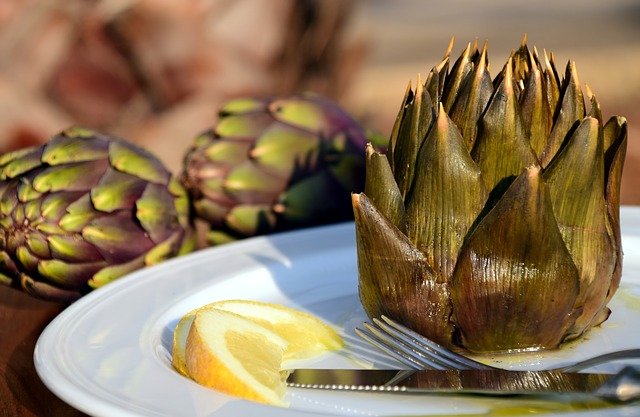
Some fish and vegetables can be completely new to you, or even the same type can taste or look different. Some ingredients are just not common to find such as dried seafood in France.
I had never seen artichoke before. photo by ulleo on Pixabay
Limited access to your hometown spices and herb. Well, let’s say we could find the main ingredient for cuisine. When it comes to spices or condiments of your home culture, you may hit bigger trouble. Spices, herb and condiments often play a critical role in determining the identity of food. In most cases, these have to be entirely imported. Only if your community is large enough then these can be produced and processed locally. In Korea and in France, I met several Chinese and Indian friends who expressed their dissatisfaction with seasonings and spices.
Fortunately, thanks to the current advanced logistics services, it is possible to obtain your home grocery items in large cities, which was not the case 10-20 years ago. Before I came to France, many people around me worried that I would miss Korean food badly. However, when I arrived, I was able to get quite a variety of Korean ingredients through the Korean and Asian grocery market in Paris. Probably, having culinary overlaps with China and Japan also helped, considering the relative size of the local Korean community.
The difference in cooking utensils can be annoying since we, nomads, have to pack lightly when we move. Asian dishes that use a strong fire and wok may be difficult to be replicated authentically in a typical European kitchen.
Depending on the country, the time slot for each meal might vary. There is no difference in meal times between France and Korea, but I remember a small surprise when I saw some of my colleagues unable to join during Ramadan.
Grocery shopping opening hour is different. In Korea, weekends are the peak times for shopping and grocery, so it is common to have longer operating hours on weekends. And also there are 24-hour convenience stores. As I was used to this, it was difficult when I first came to Paris. There weren’t any large supermarkets open on Sundays and only a few opens on Saturdays morning. So on Friday evening, I have to wait in a large queue. In recent years, a lot has changed, so many places are open until Sunday morning. However, there are still some places where liquor sales are limited on weekends. Even on weekdays, almost no shops are open after 9 p.m.
Different toilet culture. A bit far fetched topic is the toilet. Toilet access was totally free and so abundant in Korea which is not the case in Europe. So when you are enjoying nice sunlight at the park in Paris, you should know where is the closest toilet. And paying for the toilet always make me a bit uncomfortable.
There is a guide book ‘where to pee in Paris’. from the website of Fnac
And above all, if we eat a long-term unbalanced diet due to these various factors, it can have bad synergy with homesickness, which could seriously threaten our mental and physical health.
Living abroad, what I liked
Broadening my perspective on culinary cultures. France is a country with rich culinary culture, so the years I spent in France was a positive time for me. I fell in love with pastries and various sweet desserts. The company’s cafeteria has already provided quite plentiful choices and moderately high-quality food for my standards. In France, the subsidy of lunch is generally applied, I felt more comfortable to try new foods and new desserts whenever they come out. I was able to easily access Halal food (mainly influenced by North African countries) that I couldn’t find in Korea, and I was introduced to various vegetarian dishes that I would have seen with prejudice if I were in Korea. So my perspective on the diversity of food cultures has widened, and I build a strong curiosity about trying new foods.
I have improved my cooking skills. In Korea, it is easy to find a restaurant that is relatively inexpensive compared to the standard of living, whereas in France, eating out is relatively expensive. And even if there are cost-effective restaurants, it was not easy for me to find that restaurant, unlike the locals. There are quite a few Korean restaurants that serve a fairly high authenticity, but the price wasn’t comfortable for me who are used to prices in Korea. As a result, I needed to cook myself to save money or to make food that suits my taste bud. It’s not a level to be proud of, but my cooking skills have grown. For the first time, I felt the joy of cooking and seeing the reaction of people who enjoy it.
Free drinking water. Talking about Paris, I can’t help but talk about drinking water. At least Parisians seem to have a little bit peculiar pride in being able to drink tap water everywhere. It seems like a kind of philosophy that free clean drinking water should be supplied to everyone. And this is aggressively advertised by the Paris Water Authority. Among the various policies, one of the interesting ones is the cold sparkling water fountains installed all over Paris (search Fontaine à eau pétillante on Google Maps). You can drink cold carbonated water free of charge anytime except for winter. My American friend explained this to her mother, and her mother said, “They know how to use the people’s taxes properly!”
Affordable wine, cheese. When you buy wine in Korea, it comes in at almost three times the original price due to transportation costs and high taxes. So, the cost performance satisfaction I felt was great in France. This is the same for butter and cheese, so I was able to get a quality product very easily without much extra effort.
How about you?
So far these are some thought on food culture centring on my expat experiences. I did not have any specific message to deliver. I just wanted to share. I want to hear about your point of view. How about sharing your stories and ideas in the comments?
We can even just talk about food, something you find shocking, hate, love, or something you wanna brag about that you could handle. I tried French andouillette (not andouille) and I liked it. It is a type of sausage filled with intestines, it has notorious fame for its stinky smell. Even some French hates it!
“a crucial but often marginalized segment of the scientific workforce”
NATURE CAREER NEWS 19 JUNE 2020
In the middle of the pandemic, June 2020, Nature launched a remarkable project. They made a survey dedicated to postdocs, which they described as “a crucial but often marginalized segment of the scientific workforce”. The questions are about the postdoctoral experience, including “job satisfaction, career progression, working hours and financial compensation” and also COVID related issues.
After they got the results, special featured articles have been followed. These articles can give us a brief look at the current situation and even share some useful tips for junior researchers. Nature openly shares the summarized result of the survey also. I think it is worth to share with people especially for whom are insecure and burned-out. This outlook tells us that you are not alone and maybe it is not all your fault. Some articles ask for immediate action to relieve the frustration many postdocs are facing amid COVID. And discussions often lead to questioning the sustainability of the current academic job structure.
For me, this survey is a small irony, in a good way. Because Nature, one of the biggest giants in research publishing ecosystem, has been blamed for its power over the scientific community. Some people think their recent rapid growth and financial success are unfair. But here probably one of the most significant steps toward helping junior researchers has been done by this love-hatred character. It is even more impressive that they have the plan to do this kind of surveys repeatedly in the coming years.
And for those who are grad students, don’t worry. They already did a survey on the life of PhD in 2019.
Luckily we are surrounded by lots of on/offline software, smartphone apps which can help us function more efficiently. When I was small, only things available were a Franklin Planner, a small dictionary and maybe a small voice recorder. Times have been changed, there is quite a big possibility of choice for us. I want to share things that have been helpful for me and I would like to hear about what you are using.
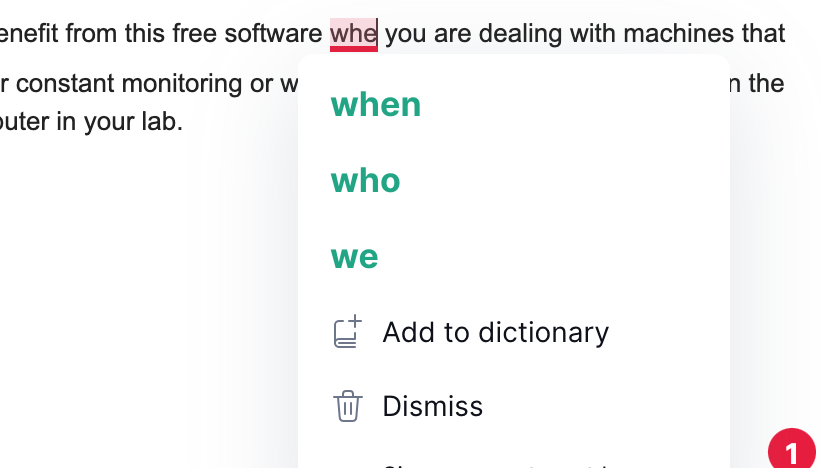
Grammar checking apps or software such as Grammarly could be really useful for non-native English users. I discovered this about 6 years ago, the performance was already not too bad at that time and I think it gets better with time thanks to data accumulation. There are other competitors in the market you could choose. I am still using this one because of its convenience. It supports multiple platforms and you could incorporate it in Microsoft Word or Chrome browser as an add-on. So while writing, like right now for me, you could see the potential errors in your writing and could get suggestions. For me their free version is already quite powerful, so the choice is completely on the users.
Grammarly
TeamViewer allows you to monitor and control your computers (even mobile devices) remotely. You can benefit from this free software when you are dealing with machines which needs your constant monitoring or when you want to access certain data in the local computer in your lab.
Reference assistant tools, like Mendeley. When we write and then submit a paper, we could face re-formatting and editing the manuscript almost inevitably. And it could be burdensome if you spend lots of time on just re-formatting and re-indexing all those references. These tools could automatically generate references list according to your target journal formatting. I used briefly ‘Papers’ so I am not sure how many new features are included in recent versions of this kind of software. Programs like LaTex is more powerful but still Mendeley kind of programs could be atrractive due to their ‘easy to use’ GUI. It can be interesting if one of you can share your opinion and experience with these kinds of writing assistant software.
Google Tasks, one of the partners of Gmail ecosystems, might be already available in your Gmail desktop version when you look at the right sidebar. Also, you can use it as a smartphone app. I use this to keep a to-do list that I should check later but things I don’t want to occupy my brain every time. For example, call someone, when my mobile plan promotion ends, write thanks postcards, check medical reimbursements, contact the insurance company before I leave France, …
Google Keep, I use this app to write down a short memo and idea. It is quite light (fast) and you can reorganize posts or pin to top. With a current voice to text technology, it can be a quite handy note taker.
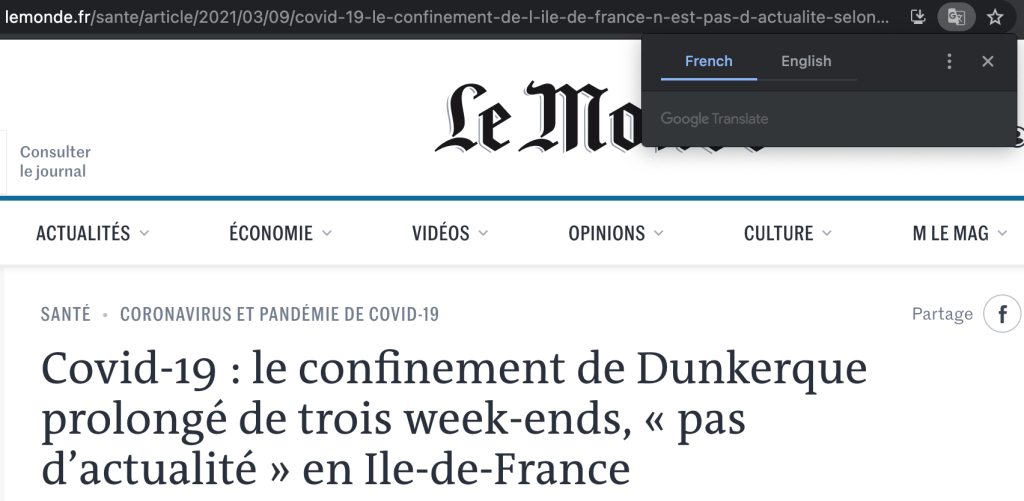
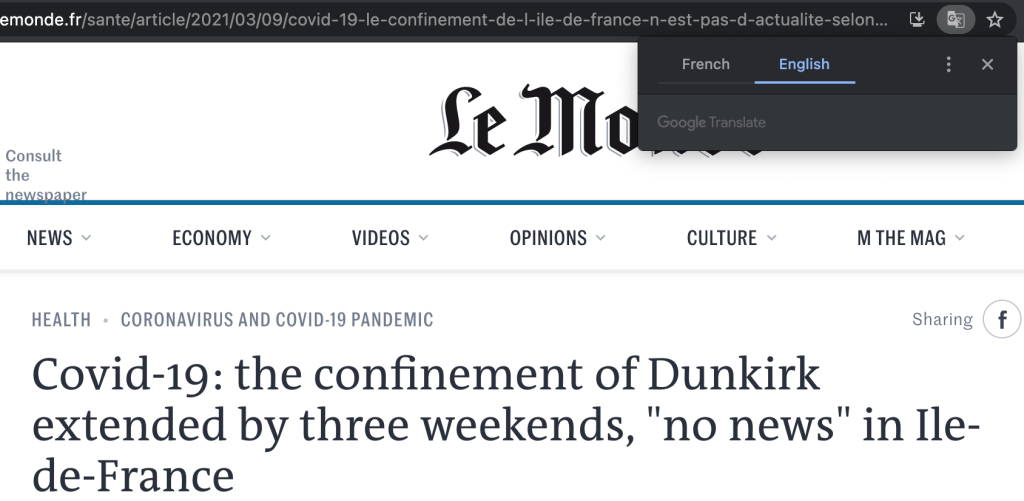
‘Translate this page’ in the Chrome browser. Google translate is already well known but this additional function was useful for me to read webpages in different languages. The translation is quite fast and done on an actual webpage by exchanging text. I want to also mention Google translate app on the smartphone which can do instant recognition of text in the picture and then perform translation. The performance of image to text recognition is quite remarkable.
Calendar apps. Making reminder of professional schedule or personal events. I realised that having a calendar view (visual view) of my schedule is quite powerful when I want to plan a vacation or professional schedule.
Any voice recorder apps. The performance of the microphone in our smartphone is amazingly good that we don’t need a separate voice recording machines at hands. You could use this to keep an important dialogue when you are in a meeting or a seminar.
Saving documents in Cloud services. I routinely scan documents and keep them in one of the cloud servers. These documents could be my contract, my proof of working experience, important receipts (rent, plane tickets),… As a research nomad, it is not easy to know which kinds of documents I should keep for the future but also it is ridiculous to physically bring them all with me. So except some documents which I should keep originals for sure, I keep the PDF files of them in the cloud and trash them.
Phyphox. This app can turn sensors in your smartphone into a physical measurement device such as pressure, magnetic field, acceleration and acoustics. This was quite convenient for me when I was changing the magnetic field of the magnet. I could monitor the change of the magnetic field in real time with my phone.
What other things you use in your daily life or professional activities?
As young as I remember I liked SF, it was fun, imaginary get away from my real world. Although I appreciate the beautiful nature around me, farm working was boring and tough. And the village was really small. So SF was always my getaway drug. On top of this, anything related to science (or even any books) considered positive from my family and the school. So I was having my secret fun. But until I got into high school I did not have the solid desire of what I wanted to be and I knew my family wanted me to be a lawyer or a doctor, which seemed quite reasonable for me considering my grade and expected financial security. Unfortunately, I did not have any mentor around me to give advice. But still, my parents were great, providing more than they can afford to support my education and possible development. For example, my family did not have electricity until I was 4 but I had my first encyclopedia when I was around 6 which cost them a fortune. And when I was around 11 I had my first PC at my house which cost them probably 6 months of earning.
After school, I always headed back to the farm even though I always wanted to play more with kids. Because I felt bad not to help my parents working. I knew how hard they try to make ends meet.
I was pretty good on the test score but not particularly only in math and science. I was good at most of the stuff because my brain functions better than friends around me (well it was a small community). For example, I was good at drawing because I have good hand-eye coordination and my spatial cognitive skills developed faster than my age. I read faster, argued better, I was bigger than my friends and stronger because I was a farmer. I mean literally, I was working like a grown man. I was already almost 170 cm tall when I was 13, which is quite tall in my community and my generation. In a way I should have been a very confident boy, on the contrary, I was not. I was introvert and sometimes overreacting to hide my fear of social interaction. I could compensate for my lack of confidence by getting good grades at school, which I have to admit that it was quite addictive.
At some point, I dreamed about being an astronaut. And before I finish my middle school I realized that as a Korean being a real astronaut is almost impossible. We cannot make a huge rocket, simply because of North Korea / USA international politics. I thought Russia and USA would not hire somebody from Korea for a manned mission to space because of national security. And I was undermining the potential of China. And more and more I realized that the SF version of a space mission is more like fantasy and it is rather similar to the military mission. In combined with a slight fear of height, I soon abandoned my dream of being an astronaut.
Since I started my high school years, things had changed. I was living in the dormitory separated from my family. I got to visit my house for only one day a month. All the schedule was managed by teachers with limited free time. The school was dedicated to training students in a certain way so they can be successful in Korean SAT test (or Korean Baccalauréat). The type of education was quite non-standard in a way because the Korean SAT is a quite atypical type of test. It consists of only ‘multiple choice’ type questions. The test was dedicated to measuring student rank nation wise. My guess is, the objective is to measure students’ understanding of high school curriculum so we can use that as a barometer to line up them. It seems now sort of national IQ test for high school graduates. But society does not want any controversy arising from the assessment which could be seen as subjective such as writing an essay. Also, the test should not be too challenging or out of the scope of high school textbooks, which considered as a gateway to unfairness between rich and poor. But in turn, making a simple mistake on the test could be disastrous. So you needed strong gut.
So as you can imagine, my study was focusing on only a few subjects which appear in the Korean SAT test. Korean language (it actually focus more on your linguistic ability), Math, Social science (history, geography, philosophy, etc.), Science, and English. Other subjects not included in the test were not considered important. So subjects like physical education, art, other foreign languages were assigned with the minimum amount of time or forbidden. Our mission was understanding the current trend of question styles in the Korean SAT and preparing for perfection. Of course, reading any materials not related to the test was strictly forbidden.
Don’t get me wrong I am still grateful to my high school for many things. For 3 years the school system removed any possible excuse to be lazy and they financially supported me during and after the school years. The teachers were working hard to provide any materials necessary. But life was tough. It was still the time that teachers could physically punish students in the name of discipline (on the level of you might have trauma later). I was sleeping average 5 hours a day and the food was not amazing. We were cleaning the dormitory and the school by ourselves. I had absolutely no privacy except toilet stool, I was living with 12 boys in the same bedroom and sharing open showers with everybody. Yeah, of course, it was only male school. Physical activity was limited too much for teenagers and constant stress was floating in the air without any exit. There were no vacation and weekends. Night snacks were forbidden under the reason of health protocol. The test scores were published openly to boost completion among students. I was healthy at the beginning but later I developed minor scoliosis due to extended time of sitting at my desk.
Fortunately, I had good attributes to excel in this type of environment. Healthy and not complaining about foods, fast reading, resource management, guessing probable answer with limited conditions and self-planned strategy for how to study. I got a pretty good mark, soon I was considered as the highest potential success project of the school. But still, I was not sure which major I should choose.
The only getaway for me during this time was listening to the radio on lunch and dinner break. Well, the news was mostly spicy, telling you lots of bad things about society, mainly people of power or rich. Like a politician, CEO of a big company and even police and prosecutors. Korea was passing through a lot of things, including the financial crisis and all the social corruption and disputes which was long-lasting aftermath of democratic movement back in the 70s and 80s. Oh and I cannot forget the day of 9/11. I was already frustrated about my life with nowhere to scream. I wanted to choose something pure but still meaningful for humanity. But bit isolated from society so I don’t have to handle these tricky aspects of real life, like money, power, and politics. Well, it seemed like science majors are good fits. The matter is which one? I was doing my own reasoning, and funny enough I concluded that Physics is coolest. I can compare my naive reasoning at that time as one thinks a certain genre of music is way cooler than others, which for now just laughingly nonsense.
This decision ignited so many fusses in my life at that time, my science teachers were not convinced I am a good enough material for Physics. Because consensus at that time was if you want to become a mathematician or physician you should prove yourself already when you are young by competing in the international or domestic science competitions, such as IMO and IPO (International Physics Olympiad). Certainly, I was not bad at math but I did not study special courses to compete in these kinds of events (way out of the scope of high school level). And my parents were extremely unhappy because the financial expectation of being a scientist seemed too small or even disastrous. They wanted me to choose a stable life. So the main focus of adults around me was only about ‘whether I could attend top university (or medical school) or not’. For the honour of family and the school and also potential stability. At that time, nobody thought about what the kids want or good at. The grades were like money you have to spend with a deadline, and you just buy the most expensive one with your budget.
I was raised as a quite obedient kid, even you could call it as a good child syndrome. Always tried to satisfy the adults around me. But this time I rebelled, disobeyed. I got more and more stubborn whenever someone said no. Fortunately, I got a pretty good mark on the Korean SAT test. The test I took was scandalously tough, which make a few of my friends panicked and failed. My insecurity or a bit of pessimism helped me this time because I prepared myself a little bit harder for the test just in case. This time it paid me back. I was accepted in the top school in my country as a Physics major, how the professors felt about my potential in my interview is another mystery.
The actual undergraduate study was not amazing for me. Youngsters in my class, all of them were extremely brilliant. I was struggling even getting in the average marks. I could not follow the lectures. I was sad when I looked around and I realised that top students are handling classes easily. I was disappointed in me but also did not want to admit that I made the wrong decision to come here. I barely graduated the school, and barely got into the grad school. Luckily my PhD supervisor was a dreamer, Prof believed that getting good marks is not an absolute necessity in doing research (nonetheless it can definitely help). Thanks to my Prof, I could regain my interest in science. I had enjoyed and struggled at the same time during grad school. I learned a lot, I could relate some of my hidden talents with research. And yes here I am. Still trying to contribute something to the community.
I realised that I did not have the ‘wow’ moment when I made a decision to choose science. It was a strange combination of naiveness, rebellion, cynicism, and pure luck. Yes, considering my situation at each time, I was and I am still amazingly lucky. So I am grateful today. As like most of the self-biography, this story is probably bit twisted and coloured in favour of my taste. But I feel quite interesting to write it down.
We all know young science nomads are not paid with a huge paycheck. And sometimes facing a high cost of living in the new society where you are working. But some of us still want to transfer money across the border for reasons like supporting family or paying a student loan. Already with the currency exchange fee, this is quite troublesome in the case of sending regularly a small amount of money. So let me show some tips about the international money transfer.
Let’s say I want to send some money to support my family. Then the first obvious option is trying my local French bank for international transfer. Sadly to the outside of the EU, it is not an easy fee. Let’s say I want to send 400 euros to Korea. My current bank offers 30 euros fixed fee for a transaction. It is quite significant compared to the money I want to send. So bigger the amount the better.
If you are lucky, then maybe one of the banks from your home country has a local branch in your foreign habitat. Or a special partnership. In that case, you would expect much better deals, with possibly better language support even.
I could use other relatively new Fintech company doing international transfer like Transferwise. Here for the same 300 euros with 6 euros fee. Although you have to check how much of exchange rate they offer, surely this is a better deal. If I want to send 4,000 euros than it is the opposite case. Because this company charges you the fee in relation to the total amount. How this company works is interesting. As far as I understand they have sizable cash deposits in each country and then when customers from both countries sending demands for exchanges they match them. let’s say I want to send money to Mr Kim in Korea. Then this company receive euros from me and put them in French deposit. Mr Kim will receive KRW from Korean deposit. Then this unbalance of each deposit will be even out later, when Jisu in Korea wants to send some money to Pierre in France. While doing this they earn money with fees. I think you can find numerous companies are doing similar business, like OFX, Xoom or more well know Western Union.
Some people would prefer the person to person exchange. Something equivalent to what Transferwise does but with people you already know or trust. ‘A’ could do transfer Korean currency from A’s Korean account to a Korean account of person ‘B’. And ‘B’ does the equivalent transaction but in French account to match it. Anyway, the advantage of ‘person to person exchange’ is clear, the charge would be minimal and you can even avoid a currency exchange fee. But I think it is in a grey area, might be illegal depending on where you live (especially the amount of exchange is relatively big).
Especially the US, having two accounts of Paypal for the US and the other country could be a neat way. Because an exchange between two PayPal account is rather not aggressive for a small amount of transfer. To do this you need two credit cards from each country.
Sometimes it might be better bringing cash with you when you visit your home country for vacation. Each country has a different law, but I think the amount of cash you can move without additional tax is around 10,000 USD worth. Without saying, we have to be careful with moving that amount of cash with us.
It depends on how much, how frequently you want to move. And also where to where. With emerging Fintech industry and Cryptocurrency recently, this post might lose its merit quite soon. But I hope it is useful to some nomads, who are not keen on money like me.
* updated 2021 MAR 9th.
If you are living in the UK or European Economic Area (EEA), you might want to check new online banks (so-called challenger bank), such as Monzo, Starling, Revoult, n26. They seem to offer quite attractive services like zero account fee. Especially if you have to send or spend currencies across the border, like wanting to pay EUR with GBP account, withdrawing EUR in France with the UK account. Some of them offer no service fee for this kind of transactions.
‘Monzo’ and ‘Starling’ are for people who have an address in the UK. ‘N26’ for EEA residents. ‘Revoult’ covers a wider target, the European Economic Area, Australia, Canada, Singapore, Switzerland, Japan and the United States.
“I can categorically say I hate impact factors!” by Nobel Laureate Martin Chalfie.
I normally do not follow Nobel prize laureate’s lectures. One reason is that I kind of become a bit bitter and sceptical towards big guys’ flashy lectures after all those years of conferences and seminars. And the other and more critical reason is that I don’t have much peace of mind (or even actual time) to sit relaxed and to watch them. But with this spicy title, I had to clickthis interview clip (We come back to Impact factor in another post). And then it was followed by his other more lengthy talk about his journey toward receiving 2008 Nobel prize in Chemistry. While doing that he also shares the myth about ‘what scientists are’. It was one of the most amazing 90 mins I spent listening to a scientist. I cannot help myself but share it here. But don’t worry there is a short 3 minutes version with a similar message. And below is the long 90 min one.
While the storytelling and also his scientific achievements are both amazing but the content grabs my mind was his description of myth about scientists. The 5 key myths are related to the common self-hatred questions for young research nomads. I think it might be worth to check out if you are feeling burning out, or having imposter syndrome. For me, his perspective is quite relatable because I am in an experimental side of science as similar to him.
Scientists are geniuses:
Some but certainly not all or not at all times. He described him as not a genius (or at least not from the early years), saying getting B grades does not mean you cannot be a scientist. He himself says his transcript from the university is not that amazing. Well, this is a partial myth because we know lots of successful scientists are crazily bright in all brainy aspects, getting the perfect marks. But the lesson he wants to give (and I want to relate) is that it is not mandatory. It is one of the arsenals that can help you but not the only one.
Scientists’ experiments always work:
Rarely. He simply states the fact. Research is usually filled with failures. It is not because we are dumb, it is because the problems we want to tackle are usually difficult. Even the question could turn out to be unanswerable with current technology. I did not know this when I get into grad school, I thought just hard-working and being smart would be only two ingredients for success in research. But the important warning was missing, you should know how to handle endless failures and learn/recover from them. Mental burnout can come easily for you because the method we subconsciously trained ourself to get good grades does not work with the same effectiveness in scientific research. And I have to add one more thing to this, the current system is biased towards to hypothesis confirmed result. That says normally no journals would publish ‘we did this, but it did not work’. So it can give us a false impression that all the good scientist always got good results. In relation to this, there is another nice youtube clip with even dipper and different point of view. I recommend ‘Is Most Published Research Wrong?’ by youtube channel Veritasium.
Scientists use the scientific method:
Rarely, usually after a discovery. This one needs a careful touch. He quotes Physicist Enrico Fermi “If the result confirms the hypothesis, then you’ve made a measurement. If the result is contrary to the hypothesis, then you’ve made a discovery.” I think what he wants to say here is not undermining our process of hypothesis and testing process. We make hypothesis and tackle, then repeat. That is what we do, scientific reasoning methodology. I think what he wants to say is that sizable discoveries would be a little bit of outreach to the current knowledge ballon. So if we are too much obsessed with coming up with a perfect plan or idea, it would be a waste of our time. Lots of experiments are needed before we see some unusual stuff. Then we do the reverse process to understand this newly revealed phenomenon. Of course with the scientific method.
Scientists work alone:
Rarely. In current days this is really true. If you are reluctant to do a collaboration or working with people who are, think again. Recently how many big works have been done with only a small group of people? We saw remarkable work from one person in 1900s, but now the time has been changed. Topics are routinely connected, one discovery excited different fields, so many instruments are needed in one project. Maybe one can say that it is because we already find out obvious stuff and remained ones are complicated. But I think we are also getting more efficient and faster by collaboration. Speed of scientific growth is faster than before by this accumulative and collaborative manner. So if you deny collaboration without any good reason, you are missing the party.
Scientist is done by white men:
Nonsense. This also needs more interpretation. This one is more in the future tense. More like he wishes. And he actually shows the list of famous figures in science, which is predominantly white male, European and American origin. Then he shows his lab members, mixed gender, nationality, it is diverse. The message is the direction we have to go. Any ethnicity or gender can do good science. We are losing potential great scientists by excluding them. In other interview, he talks about gender ratio in his department which is still not enough. So he is raising awareness and try to encourage young scientist.
Probably my taste interprets his lessons with a slight twist. But I was happy to hear some of his idea about scientists. It quenched my thirst of wondering about ‘what makes a scientist’. Things I vaguely have realised recently by myself (with fragile confidence) after lots of trial and errors in my works are endorsed by a successful scientist like him. Surely I should not lean on his fame to argue something, but damn it feels comforting.
Language could be the biggest trouble in your life when you move out of your home country for studying or work. This somewhat quite trivial reasoning was not actually obvious for me. Well, let’s admit it, schools never teach you something really useful in your life.
We researchers (or students) frequently assume that if you can use a somewhat ok level of English then you can survive anywhere. Journals are written in English, we do presentations in English and even your thesis sometimes written in English. English English English, so if you are ok with it then you should be ok when you are outside huh?
But the reality is not that simple. And I should have already realized this when I was working in my first postdoc laboratory, which was a Korean one. The first clue came to me when I asked the lab office for the English version of my contract. My original one was in Korean and I did not think twice when I signed it.
Even though the majority of members were Korean, it was a huge lab and quite international. I had many foreign postdoc colleagues, few exchange students, some senior position researchers and even visiting faculties from other institutions. All had diverse backgrounds. So without a doubt, I thought there should be the official English version of contract form. But the response I got was shocking, THERE WAS NO ENGLISH VERSION!
So I had to translate it by myself, luckily worked for me. But what about my foreign colleagues? As far as I remember nobody even speaks some Korean! They might have to go to a sworn translator with legal authority. When I was in Korea, of course, I had no problem with language. I am native. Because of that I was so blinded to the difficulties for foreign students and researchers who chose Korea for their new habitat. With quite a homogeneous ethnicity and culture, these issues have been frequently ignored or not been dealt with seriously. Back in Korea, I was a fish in a small pond.
Imagine that you just arrived completely new world because you got offered a job for a few years. Then you realise you have to sign the contract that you cannot even read! Now try to imagine opening a bank account, getting a phone number and finding accommodations. With limited budget and time. Yeap, life can get quite tough… I don’t have to mention that you have to adujust yourself fast in new research environment which is already mind blowing.
Now the situation is reversed, I am in France for a new job. And I am signing my contract… yeah I could not even understand how much vacation I have. Lucky for me I have help from the new technology, ‘Google translate’ is working magically. Praise Google and smartphone! But still, I had to memorize desperately the sentence “Je suis désolé, vous parlez anglais?” which is ” I am sorry, do you speak English?”
I guess every organisation can have its own reason (mainly legally) to prefer their own mother tongue. And also I am not super happy with language dominance of one language, aka English in science. Anyway, I am in a minority language group and native English speakers get some unintentional benefits. But still, I think there should be some kind of awareness of this problem for young researchers. Unions are non-existence or not strong enough for students and postdoc and even if you have any, yes! again the language barrier. So foreign science nomads always become vulnerable in every possible aspect in their life
Don’t get me wrong, I am grateful that I had landed in France. I had amazing help here. Special accommodation dedicated people like me, ‘Cité internationale universitaire de Paris’. My colleagues and administration were helpful. English proficiency is uncomparable to Korea and especially for the younger generation. Numerous orgnisaations helping students and researchers from outside, such as Sicence Accueil. And my company is willing to pay for my French classes. I am pretty sure I was much much better off than my foreign friends in Korea.
But it still bothers me. Probably somewhere in the world a young researcher who was excited and motivated about experiencing a new culture and society, suddenly realize that life is tough and when you need help you don’t even know where to ask. Learning a new language is an amazing thing, I cannot agree more. This is the best way to immerse yourself to the new environment. I am a strong believer, I tried French classes. But you are a nomad, you are not sure where you would work next year. Even you are not sure whether you would continue working on research. And your career is hanging on your result, global competition, everybody is brilliant, competitive, your publication date should be yesterday. Here ‘working hour per week’ does not mean anything. I believe that for many nomads like me, sadly they had to take a side between work and learning a new language. Like a movie cliché, career or love?
I don’t know a good solution to this. Every society has different rules and regulation. And we nomads do not really bring big economic impact usually. We are not cost-effective. But if we believe that science is not only about growth and economy but more about advancing and sharing knowledge without borders, we need something here. It could be a skill-sharing organisation with a group of bilingual, offering free translation with minimal cost? Or maybe global agreement on providing English document for foreign fixed-term researchers. What do you think?






 Coffee Break Special