Living abroad helped me see through other person’s point of view, especially expats who stay in Korea. Now I can roughly picture the difficulties that foreigners living in Korea would face. There are a few things I heard from friends, but most of the stuff I have written here is the recent epiphany, being in expats’ shoes, after suffering in a foreign land.
Korea has been a relatively closed society for expats. It is geographically isolated like a big island because of North Korea and 3 coastlines. It has not been long since people started crossing the Korean border in earnest as it can be seen from the fact that even Korean citizens began their free international travel without discrimination in 1989. We have historical scars with our two closest neighbours, Japan and China. So, the only foreigners I saw before I became an adult were the US soldiers who came to my valley for military training. And since it is a country mainly composed of a single ethnicity with a single culture, it seems that our capacity to deal with cultural differences is not mature yet. Hopefully, this might change soon. The number of foreigners has increased quite a bit on the streets of Seoul when I recently visited. For simplicity of the topic, here let’s talk about food culture.
- Food difficulties you can have in Korea
Lack of understanding of dietary requirements. The fact that Koreans do not have special dietary restrictions can lead to a lack of understanding and consideration for cultures with special food ingredient restrictions. We are really not used to this concept. So, when foreigners start living in Korea, it can be difficult for them to satisfy their preferred eating habits.
Vegetarian and gluten-free? For example, if my parents’ generation meets someone who is looking for a strict vegetarian diet, no matter what the situation is, they will ask ‘WHY?’ without hesitation and may insist that you should eat meat. Because when they were young, any kind of meat was a rare and special ingredient, lots of them suffered from the deficiency of animal protein. Anyhow, most restaurants owners are older generations so it could be not easy for you to ask them whether they have a vegetarian menu and get a positive response. For a similar reason, gluten intolerance is almost unheard of in Korea.
Halal foods. People with Halal food culture may face many prejudices in Korea, where people love pork, especially obsessed with grilled pork belly (Samgyeopsal 삼겹살, if interested check Netflix series ‘Korean Pork Belly Rhapsody’). In Korea, the scenery of sharing glasses of soju with grilling pork-belly is almost iconic for co-workers parties. As you can imagine it is really difficult to find Halal foods in your local supermarkets. You might want to visit a certain district where sizable Muslim communities reside.

How about kimchi? (김치: fermented salted spicy vegetable) It may become a bit better known through the mass media nowadays, but I think it is completely normal when a foreigner tries kimchi for the first time and she/he is shocked. As it is a fermented food, it has a strong smell, sour taste, peculiar texture, and even spicy taste. Although we eat them almost every meal, some Koreans hated kimchi when they were small, sometimes their parents fed it to them semi-forced. Although I love it, I think some Koreans do tend to recommend kimchi to foreigners with a bit too much eagerness.
Using spicy pepper everywhere. Unless you’re a spicy pepper lover you have to be careful in Korea. By my standards, the average French (or European) has a weak tolerance for spicy peppers. These people should be careful when ordering food in Korea. It is quite common to use a generous amount of pepper in Korean cuisine and when native servers in Korea say that ‘it is not spicy’, that is not the zero level of spiciness that you think it is.
Koreans love garlic. We already use quite a generous amount of garlic when we cook with heat, but we also use plenty of raw garlic, which is sometimes close to the level of vegetables rather than spices. So if you don’t like garlic, you may want to be picky at the beginning.
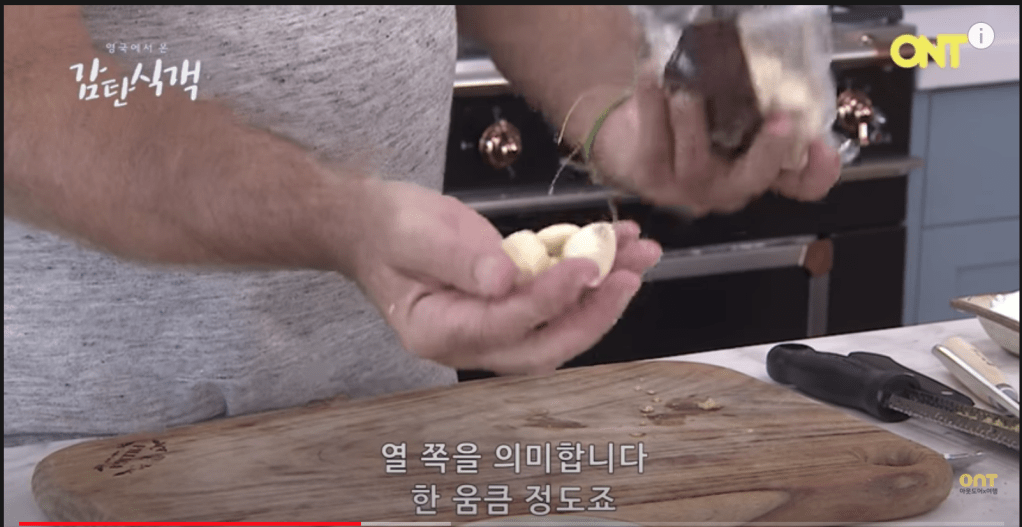
“in Korea, a bit of garlic means about 10 cloves…” – John Torode
You may be surprised by the strange flavours of sesame leaves, which are commonly used as fresh vegetables.
Limited dairy products. If you love cheese, you may find yourself frustrated with dairy products that lack both quality and variety. As can be seen from the fact that the first successful modern cheese production was accomplished by a Belgian missionary only in 1969, Korea does not have a rich dairy culture.
Lamb and mutton, sorry it is not that common to find them in local shops. You wanna go to certain foreign (means non-Korean) restaurants or some district with lots of foreigners. Ah if you go to any Chinese districts, you will find nice restaurants serving lamb skewers on the grill (양꼬치). I recommend trying them with an ice-cold beer!

Low awareness of food allergies. Food allergens, such as shrimp and peanut allergies, are also an important difference. In Korea, food allergies are generally not taken very seriously. The symptoms of serious food allergies seem to be few. There might be a bit of underestimation because only recently awareness has been raised and only a few related research has been established. But still, the difference seems obvious. For example, the occurrence of food-related anaphylaxis (severe allergic reaction such as difficulty breathing) in children under the age of 18 is about 1/50 compared to the United States. Probably there are some differences in genetics and dietary habits. Maybe this has something to do with the sad past when everybody was starving? In the dark time, only the strong survived…
They don’t drink water from the tap. Surprisingly, only a small portion of Koreans are drinking water from the tap. If you have lived in a country like France, Canada, or Japan, you may be surprised by this. The ratio of the population who directly drinks tap water is only 5% and it is the lowest level in OECD. Whatever the cause, having to pay the additional cost for drinking water could be annoying for an expat.
Strange communal spoon dipping. It’s getting a lot better these days, but ‘communal dipping’ will baffle a lot of expat. This is an act of eating while everyone dipping a spoon in one large pot instead of serving it in a private small bowl. It usually happens when you eat hot soup or desserts like ice-cream. This one I don’t have any good defence. It seems to have started mainly at the family table and expanded to the concept of expressing intimacy with others as well (but how?).
Personally, while living in Korea, I always wondered why most people are ok with it. Especially after the understanding of cancerous gut bacteria Helicobacter, which can be transmitted by saliva.
Many Koreans still tend to regard this as our warm tradition, but in fact, strictly speaking, the original Korea table manner was everybody getting their own small table. Probably, the culture had lost and changed as we went through a difficult period of starvation after the Korean War. I think with coronavirus pandemic, this will disappear rapidly due to increased sanitary concerns.
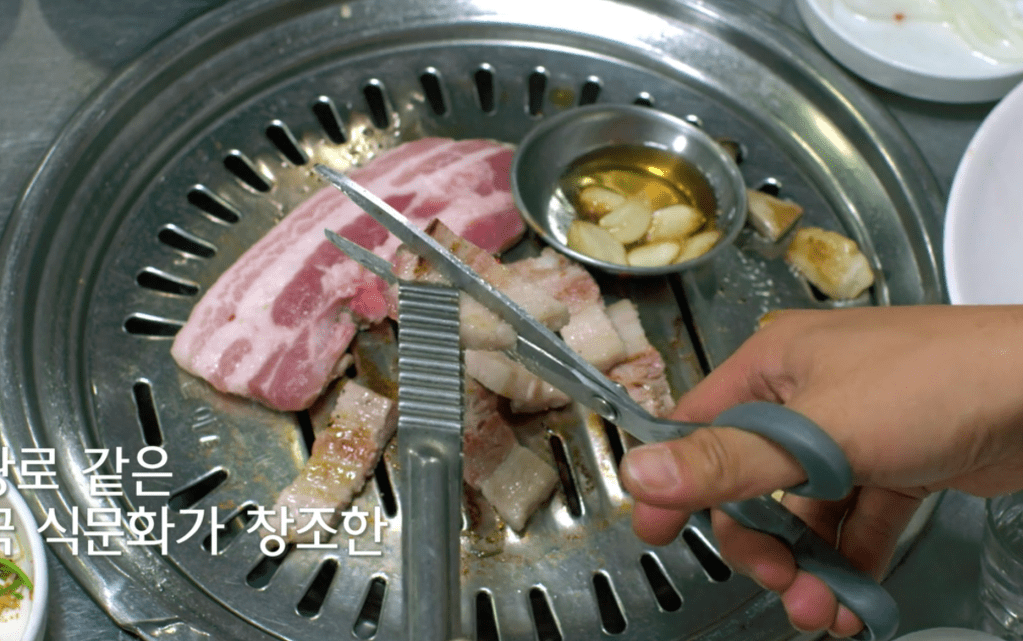
They cut food with scissors. There are many people who feel unfamiliar with kitchen scissors, which are commonly used in restaurants and homes to cut foods in Korea. It seems odd because they are reminiscent of office supplies. But personally, I think it’s convenient.
Seating on the floor culture could be tough for you. There are still quite a few restaurants that don’t have chairs so you take a sit on the floor with a low table. On top of this, you have to take off your shoes. For some people, you may feel like you’re being punished or doing yoga while dining.

Heavy breakfast. In the case of a family who eats old fashioned way, the composition of breakfast, lunch and dinner does not change significantly, and this makes breakfast considerably heavier in quantity and appearance compared to other cultures. Spicy food, meat, and hot food are commonly served for breakfast.
Offering drink too often at the party. When drinking booze, we are too much concerned about the empty glass of others, we think refilling your glass is equivalent to being polite. So those expats who want to drink at their own pace may feel that Koreans tend to offer drink too much. In the past, liquors were precious, drinking them was a special event. Probably because producing alcohol is an act of reducing the nutritional value of the grain. So, it seems that offering alcohol has been translated into the meaning of conveying hospitality and goodwill.
- There should be good side also
I would like to mention some of the possible good aspects of food culture in Korea. Since it is a country that is not well known, it will be fun to discover new things. There are few restrictions on ingredients. As food delivery (delivery in general) is extremely well developed, people sit in the park and can get beer and chicken delivered, sit in the ballpark and receive barbecue delivery to the seat, and even order food delivered at 3 am. The cost of eating out is relatively cheap compared to the price of living. With the low crime rate and 24 hours open restaurants and convenient stores, you can safely enjoy drinking and eating out any time of the day.
If you are gluten intolerant, Korea might be not that bad for you. Korean staple grain, rice is gluten-free. It cannot completely replace wheat, but its abundance and variation of its cooking might be a surprising delight for you.
In most restaurants, side dishes are refilled for free. When I lived in Korea, I hadn’t thought about this as an advantage, but I remember being shocked to see that I had to buy each side dish at a Korean restaurant in Paris. Also, no matter which restaurant, office, or school you go to, the drinking water provided by the water purifier is always free.
Korea has a culture that expects a fairly high level of kindness from the servers. Servers’ kindness perceived as a duty, so even in the case of a mid to low price range restaurant, you can get bit awkwardly kind servings. Considering that it is a country that has no tipping culture at all, this might be surprising. Oh, there might be a difference in how they treat Koreans and foreigners (I hope not..).
I believe this topic can be further expanded by someone who has lived in Korea!
 Coffee Break Special