Many science nomads are investing in their careers at almost 100% expense of their own vacation and hobbies, but eating is different. Because you can’t live without eating. Eating is an instinctive pleasure and also a basic action for survival. In that sense, living as an expat can be an indirect opportunity to broaden your insights on food culture or it can be big trouble in some situation. There are a number of factors. The ingredients vary depending on the climate and culture, you will encounter new cuisine, and you will see different cooking methods and eating out/delivery cultures. In addition, food ingredients and recipes have different constraints for various reasons depending on the individual and the culture. For example religious reasons, vegetarianism, organic preferences, and food allergies. You might feel difficulties from food more pronounced during the coronavirus time. People crave their comfort food when they are under stress. I want to share some thoughts about food, in relation to living abroad temporarily.
- I’m a lucky person when it comes to eating
After spending several years outside my home country, I realized that I am quite lucky to have unlimited dietary habits. I was not aware of it before and then my eyes opened up when I met people with strict vegetarians, halal culture, and gluten intolerance (Celiac disease) that were rarely seen in Korea.
Koreans certainly miss their usual tastes, but as far as I know, we don’t have any strong ingredients restrictions. There are no religious restrictions on food in Korea, and because of freezing winter and scorching summer, preserved foods using salt and fermentation have developed widely. Vegetables are also abundant because of the tough past when protein from livestock was quite scarce. In addition, in most regions, the coastline is not far away, so seafood is also abundant and raw seafood is consumed commonly just like in Japan. And for some reason, food allergies are not so common.
In addition to this, I was raised in a rural, non-wealthy family, so being picky about food was a luxury to me. In my childhood, wild animals were hunted in the mountains, wild plants were harvested, vegetables, grains and poultry were raised on our farm, and seafood was common because of the close proximity to the ocean. Growing up as a farmer’s child, I am a little pessimistic about organic farming, so I don’t particularly prefer organic foods. I have slight lactose intolerance (but I like cheese). Thanks to these backgrounds, my dietary life abroad was relatively exciting, positive, and enjoyable.
- Food-related difficulties we encounter while living abroad
Unfamiliar ingredients or their name in the local language. Before we move to new countries, studying the food culture of the destination is not the first thing that comes in our mind. So we realise the food-related problem on day 1 or 2. Let’s say you go to the grocery store. First, you don’t have the same items as back home. Even if the ingredients you want are sold locally, chances are you probably don’t know their name in the local language. Let’s think about meat. In different cultures, they have a different way to cut and name each part of the meat. So it is difficult to order the exact same meat part if you are not culinary experts. Even some meat products have different legal regulation as to whether they are edible or not, in the case of organs and bones. So no matter how powerful Google Translate is or you have become fluent in the local language, it is always challenging.
Some fish and vegetables can be completely new to you, or even the same type can taste or look different. Some ingredients are just not common to find such as dried seafood in France.
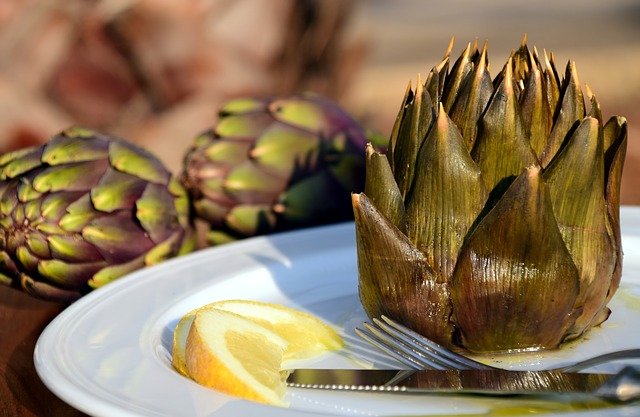
I had never seen artichoke before. photo by ulleo on Pixabay
Limited access to your hometown spices and herb. Well, let’s say we could find the main ingredient for cuisine. When it comes to spices or condiments of your home culture, you may hit bigger trouble. Spices, herb and condiments often play a critical role in determining the identity of food. In most cases, these have to be entirely imported. Only if your community is large enough then these can be produced and processed locally. In Korea and in France, I met several Chinese and Indian friends who expressed their dissatisfaction with seasonings and spices.
Fortunately, thanks to the current advanced logistics services, it is possible to obtain your home grocery items in large cities, which was not the case 10-20 years ago. Before I came to France, many people around me worried that I would miss Korean food badly. However, when I arrived, I was able to get quite a variety of Korean ingredients through the Korean and Asian grocery market in Paris. Probably, having culinary overlaps with China and Japan also helped, considering the relative size of the local Korean community.
The difference in cooking utensils can be annoying since we, nomads, have to pack lightly when we move. Asian dishes that use a strong fire and wok may be difficult to be replicated authentically in a typical European kitchen.
Depending on the country, the time slot for each meal might vary. There is no difference in meal times between France and Korea, but I remember a small surprise when I saw some of my colleagues unable to join during Ramadan.
Grocery shopping opening hour is different. In Korea, weekends are the peak times for shopping and grocery, so it is common to have longer operating hours on weekends. And also there are 24-hour convenience stores. As I was used to this, it was difficult when I first came to Paris. There weren’t any large supermarkets open on Sundays and only a few opens on Saturdays morning. So on Friday evening, I have to wait in a large queue. In recent years, a lot has changed, so many places are open until Sunday morning. However, there are still some places where liquor sales are limited on weekends. Even on weekdays, almost no shops are open after 9 p.m.
Different toilet culture. A bit far fetched topic is the toilet. Toilet access was totally free and so abundant in Korea which is not the case in Europe. So when you are enjoying nice sunlight at the park in Paris, you should know where is the closest toilet. And paying for the toilet always make me a bit uncomfortable.

There is a guide book ‘where to pee in Paris’. from the website of Fnac
And above all, if we eat a long-term unbalanced diet due to these various factors, it can have bad synergy with homesickness, which could seriously threaten our mental and physical health.
- Living abroad, what I liked
Broadening my perspective on culinary cultures. France is a country with rich culinary culture, so the years I spent in France was a positive time for me. I fell in love with pastries and various sweet desserts. The company’s cafeteria has already provided quite plentiful choices and moderately high-quality food for my standards. In France, the subsidy of lunch is generally applied, I felt more comfortable to try new foods and new desserts whenever they come out. I was able to easily access Halal food (mainly influenced by North African countries) that I couldn’t find in Korea, and I was introduced to various vegetarian dishes that I would have seen with prejudice if I were in Korea. So my perspective on the diversity of food cultures has widened, and I build a strong curiosity about trying new foods.
I have improved my cooking skills. In Korea, it is easy to find a restaurant that is relatively inexpensive compared to the standard of living, whereas in France, eating out is relatively expensive. And even if there are cost-effective restaurants, it was not easy for me to find that restaurant, unlike the locals. There are quite a few Korean restaurants that serve a fairly high authenticity, but the price wasn’t comfortable for me who are used to prices in Korea. As a result, I needed to cook myself to save money or to make food that suits my taste bud. It’s not a level to be proud of, but my cooking skills have grown. For the first time, I felt the joy of cooking and seeing the reaction of people who enjoy it.
Free drinking water. Talking about Paris, I can’t help but talk about drinking water. At least Parisians seem to have a little bit peculiar pride in being able to drink tap water everywhere. It seems like a kind of philosophy that free clean drinking water should be supplied to everyone. And this is aggressively advertised by the Paris Water Authority. Among the various policies, one of the interesting ones is the cold sparkling water fountains installed all over Paris (search Fontaine à eau pétillante on Google Maps). You can drink cold carbonated water free of charge anytime except for winter. My American friend explained this to her mother, and her mother said, “They know how to use the people’s taxes properly!”
Affordable wine, cheese. When you buy wine in Korea, it comes in at almost three times the original price due to transportation costs and high taxes. So, the cost performance satisfaction I felt was great in France. This is the same for butter and cheese, so I was able to get a quality product very easily without much extra effort.
- How about you?
So far these are some thought on food culture centring on my expat experiences. I did not have any specific message to deliver. I just wanted to share. I want to hear about your point of view. How about sharing your stories and ideas in the comments?
We can even just talk about food, something you find shocking, hate, love, or something you wanna brag about that you could handle. I tried French andouillette (not andouille) and I liked it. It is a type of sausage filled with intestines, it has notorious fame for its stinky smell. Even some French hates it!
 Coffee Break Special